You pay for every click on your Google Ads or social media campaigns. When a user clicks your ad but leaves your site without calling or filling out a form, you lose money. This is why PPC landing page best practices are critical for local businesses in Tacoma and the Puget Sound. A strong landing page converts traffic into qualified leads. It ensures that the budget you spend on clicks actually drives revenue for your business.
GreenHaven Interactive has managed digital marketing for local service businesses since 1994. We know that getting traffic is only half the battle. You need that traffic to take action. This guide covers the essential PPC landing page best practices you need to follow. We will look at message match, form optimization, speed, and tracking to help you stop wasting your ad budget.
Contents
Message Match Is Critical for Conversions
Message match is one of the most important PPC landing page best practices. It refers to how well your landing page matches the promise made in your ad. If a user searches for “emergency roof repair in Tacoma” and clicks an ad with that headline, they expect to see “Emergency Roof Repair” on the page. If they land on a generic home page or a list of all your services, they will likely bounce.
When the ad copy and the landing page headline align perfectly, visitors know they are in the right place. This reduces confusion and keeps them engaged. Good message match also improves your Quality Score in Google Ads. A higher Quality Score can lower your cost per click.
You should create specific landing pages for each core service you advertise. Do not send paid traffic to your home page unless the ad is strictly for general branding. For example, if you are running ads for SEO services, link them directly to a dedicated page about Search Engine Optimization. This ensures the user finds exactly what they were looking for immediately.
Keep Lead Forms Simple and Functional
The goal of your landing page is to get a lead. Complicated forms hurt your conversion rate. One of the standard PPC landing page best practices is to ask for the minimum amount of information needed to start the sales process. For most trades and professional services in Seattle and Tacoma, you usually only need a name, phone number, and email address.
Every extra field you add to a form increases friction. Users on mobile devices specifically hate typing out long responses. If you do not need their home address or a detailed project description right away, do not ask for it. You can get those details when you call them back.
Test your forms regularly to ensure they work. A broken form is a disaster for your ROI. Make sure the submit button is large and uses action-oriented text like “Get My Free Quote” rather than a generic “Submit.” If you are unsure if your current forms are effective, we can review your setup. Our team has decades of experience helping businesses grow. Read more about our background on Our Story.
Use Local Social Proof to Build Trust
Trust is a major factor in conversion. Visitors need to know you are a legitimate business before they hand over their contact information. Including social proof is among the most effective PPC landing page best practices. This includes testimonials, star ratings, and badges from local organizations.
For a business in the Puget Sound, local context matters. A testimonial from a customer in Puyallup or Gig Harbor carries more weight than a generic quote. If you belong to a local chamber of commerce or have specific certifications, display those logos clearly.
Visual proof also helps. Before and after photos are powerful for landscaping, roofing, and construction clients. You can see examples of how we display work in our Portfolio. Seeing real results helps potential customers feel confident that you can solve their problem.
Page Speed Impacts Quality Score and Leads

Mobile users in Washington are often on the go. If your landing page takes more than three seconds to load, you will lose a significant portion of your traffic. Fast load times are non-negotiable PPC landing page best practices.
Google uses page speed as a factor in its ranking and Quality Score algorithms. A slow page frustrates users and signals to Google that your experience is poor. This can result in your ads showing less often or costing more per click.
You can check your page speed using tools provided by Google. Optimizing images, using clean code, and having reliable hosting are all ways to improve speed. If your current site is sluggish, it might be time to look at technical improvements. You can learn more about how we handle site performance and Social Media Management to ensure all your traffic sources land on fast pages.
Tracking Conversions in GA4
You cannot improve what you do not measure. Proper tracking is the foundation of all PPC landing page best practices. You must know which keywords and ads are generating leads. Google Analytics 4 (GA4) allows you to track specific events like form submissions and phone number clicks.
Setting up conversion tracking allows you to see the true ROI of your campaigns. You can identify which ad groups are wasting money and which are profitable. This data allows you to optimize your budget by shifting funds to the high-performing areas.
Google provides detailed documentation on setting up GA4 conversion events to help you get started. Without this data, you are flying blind. We recommend auditing your tracking setup before launching any major spend.
A PPC landing page best practices Checklist for Service Leads
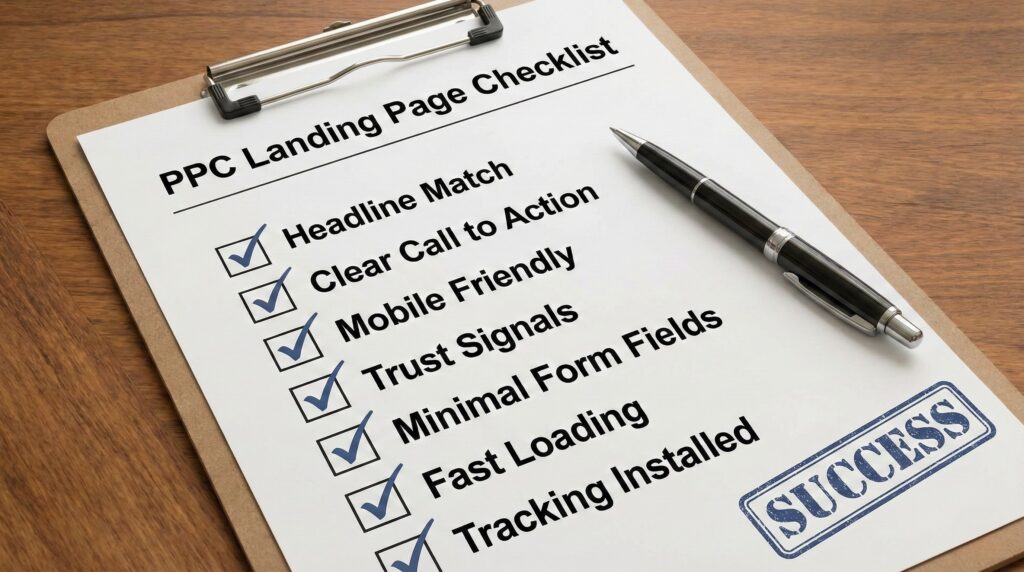
Implementing PPC landing page best practices can feel overwhelming if you try to do everything at once. Use this checklist to review your pages before you launch a campaign. This ensures you cover the basics that drive conversions for service businesses.
- Headline Match: Does the H1 headline match the ad text?
- Clear Call to Action: Is the phone number or form easy to see immediately?
- Mobile Friendly: Does the page look good and load fast on a smartphone?
- Trust Signals: Are there reviews, location details, or accreditation logos?
- Minimal Form Fields: Are you asking only for name, email, and phone?
- Fast Loading: Does the page load in under three seconds?
- No Navigation Leaks: Did you remove the main menu to keep users focused?
- Tracking Installed: Is the Google Ads tag and GA4 event tracking active?
- Local Relevance: Do you mention Tacoma, Seattle, or your specific service area?
- Https Secure: Is the page secure to protect user data?
- Offer Clarity: Is the service offer simple and easy to understand?
- Contact Info: Is your business name, address, and phone (NAP) visible?
For more insights on digital marketing strategy, visit our Blog hub.
Trust GreenHaven Interactive With Your Campaigns

Applying these PPC landing page best practices will lower your costs and increase your leads. A well-optimized page turns clicks into customers. It respects the user’s time and builds trust in your brand immediately.
GreenHaven Interactive helps businesses in Tacoma and the greater Puget Sound get more from their digital marketing. We focus on pragmatic strategies that deliver measurable results. If you are ready to stop wasting ad spend and start seeing real leads, we are here to help. Contact us today to discuss your project. Visit our Contact page to get started.
What are PPC landing page best practices to improve conversion rates?
Start with a clear and compelling headline, use engaging visuals, ensure fast loading times, and include a strong call-to-action (CTA). Align your content with ad copy to maintain relevance.
How important is mobile optimization in PPC landing page best practices?
Mobile optimization is crucial since a significant portion of users access ads on mobile devices. Ensure your landing page is responsive, loads quickly on mobile, and has easy navigation for a seamless experience.
Should I include forms on my PPC landing page?
Yes, forms are essential for lead generation. Keep them short and simple, requesting only necessary information to reduce friction and increase the likelihood of conversions.
How can I use A/B testing as part of PPC landing page best practices?
A/B testing allows you to compare different versions of your landing page to see which performs better. Test elements like headlines, images, CTAs, and layout to continually optimize for better conversion rates.
What role does page speed play in PPC landing page best practices?
Page speed is critical because slow-loading pages can lead to high bounce rates. Optimize images, minimize code, and leverage browser caching to ensure your page loads quickly for visitors.
Is it necessary to match my PPC ads with my landing page content?
Absolutely. Matching your PPC ads with landing page content enhances relevance, improves user experience, and boosts quality scores, leading to better ad performance.
How can visuals enhance my PPC landing page best practices?
Engaging visuals can capture attention and convey your message quickly. Use high-quality images or videos that are relevant to your offer, helping to create an emotional connection and drive conversions.
What is the importance of a strong call-to-action in PPC landing page best practices?
A strong call-to-action (CTA) guides users towards the desired action. Make it clear, actionable, and visually distinct to encourage conversions, whether it’s signing up, making a purchase, or requesting more information.