
You own your customer list. You do not own your social media followers. This distinction is the most important reason why email marketing for small business remains a critical strategy for growth in the Puget Sound region. Algorithms change and ad costs rise, but a direct line to your customer’s inbox allows you to control the message and the timing.
For local business owners in Tacoma and Seattle, email marketing for small business provides a way to stabilize revenue. Email marketing for small business turns one-time buyers into repeat clients and keeps your brand top-of-mind when a homeowner needs a roof repair or a business needs professional services. GreenHaven Interactive has helped local companies build digital footprints since 1994, and we see email as the engine that powers long-term retention.
This guide outlines a practical strategy for building a list, automating your welcome messages, and reactivating quiet leads.
Contents
Why a List Strategy Matters
Many owners treat email marketing for small business as an afterthought. They might send a sporadic newsletter or a holiday greeting, but there is rarely a cohesive plan. A real strategy moves a prospect from “interested” to “customer” to “advocate.”
When you rely solely on social media or search traffic, you are constantly hunting for new leads. An email list captures the traffic you already earned. If you are investing in SEO to drive visitors to your site, you need a mechanism to capture their information before they leave. Most visitors will not buy on their first visit. If they leave without subscribing, that opportunity is likely lost.
A structured email marketing for small business list strategy allows you to segment your audience. You can speak differently to a commercial client in Fife than you do to a residential homeowner in North Tacoma. This relevance drives open rates and conversions.
The Lead Magnet: Trading Value for Access
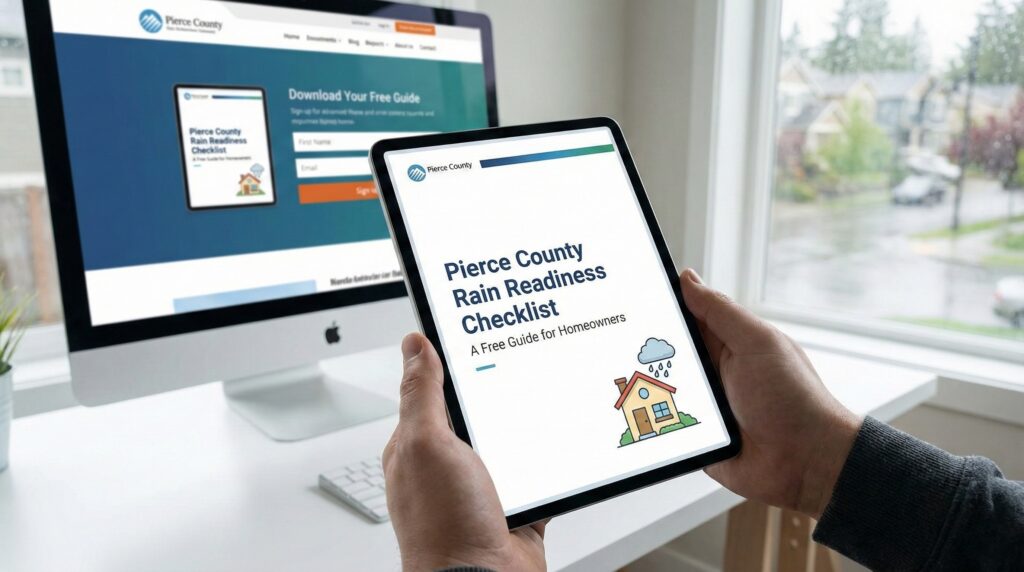
People rarely give away their email addresses for “updates.” They need a concrete reason to subscribe. In the context of email marketing for small business, this incentive is called a lead magnet. It is a free asset you provide in exchange for contact information.
For a trade business, this could be a maintenance checklist or a seasonal guide. For example, a roofer might offer “The Pierce County Rain Readiness Checklist.” A CPA might offer “5 Tax Deductions Tacoma Small Business Owners Miss.”
The lead magnet must solve a small, specific problem immediately. It does not need to be a fifty-page ebook. A simple PDF or a video walkthrough often works better because it is easy to consume. Once you have this asset, you place it prominently on your website. You can see examples of how we integrate calls-to-action in our Portfolio.
The Welcome Series: Your Digital Handshake
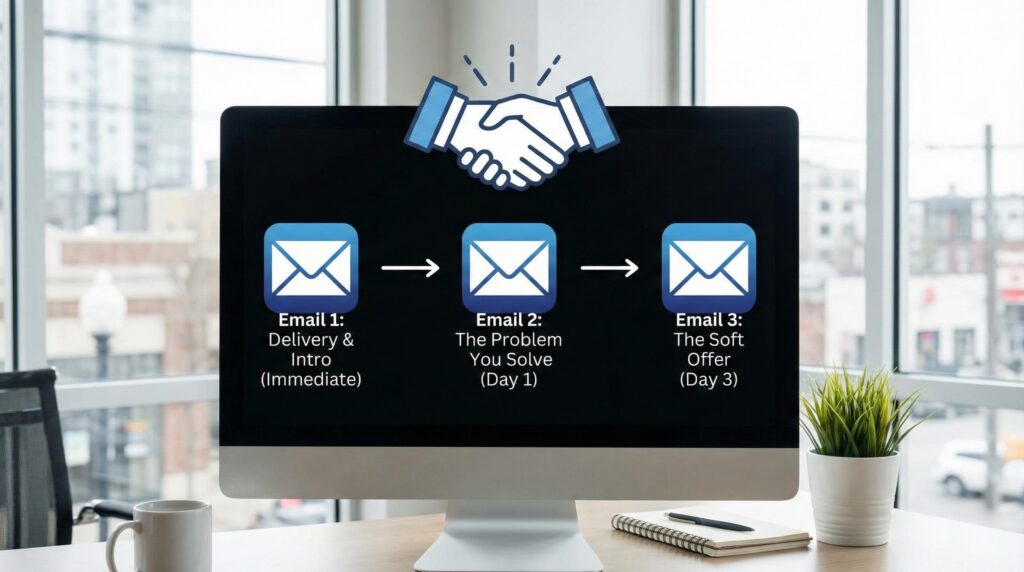
Once a user downloads your lead magnet, the automation begins. The welcome series is the most opened sequence in all of email marketing for small business. This is your chance to set expectations and build trust without manually typing an email every time a lead comes in.
We recommend a three-part welcome flow for most service businesses.
Email 1: Delivery and Introduction
Timing: Send immediately.
Subject Line: Your [Name of Guide] is inside + Welcome to [Company Name]
Deliver the lead magnet immediately. Do not make them wait. Introduce your company briefly. Keep the tone helpful and low pressure. Tell them what to expect from your future emails so they do not unsubscribe.
Email 2: The Problem You Solve
Timing: Send 1 day later.
Subject Line: Why most [Industry] projects fail
Address a common pain point. If you are a landscaper, talk about the challenges of moss in the Pacific Northwest. If you are in finance, discuss local compliance issues. Show that you understand the specific challenges facing email marketing for small business owners or homeowners in our region. This establishes authority.
Email 3: The Soft Offer
Timing: Send 2 to 3 days after Email 2.
Subject Line: How we can help you with [Service]
Now that you have provided value, invite them to take the next step. This could be scheduling a consultation, booking a site visit, or calling your office. Remind them of your local roots in Tacoma or the South Sound, which builds trust compared to national chains.
Nurture Sequences: Staying Top of Mind

After the welcome series, your lead enters the nurture phase. Email marketing for small business fails when you go silent for months and then suddenly ask for a sale. Consistency is key.
A nurture sequence can be a weekly or monthly newsletter. It should focus on education rather than hard selling. Share recent project photos, link to a new post on your blog, or discuss seasonal maintenance.
If you handle Social Media Management, you can repurpose that content for your emails. A popular post on Facebook often makes a great topic for a nurture email. The goal is to remind the subscriber that you are active and available. When they eventually have a need, your name should be the first one they think of.
Reactivation Flows: Waking Up Dead Leads

Every list has subscribers who stop opening emails. A reactivation flow is a specific tactic in email marketing for small business designed to win them back or clean your list.
Identify subscribers who have not opened an email in six months. Send a re-engagement campaign.
Email 1: “Are you still looking for help with [Service]?”
Email 2: “We have updated our service area in Pierce County.”
Email 3: “Should we take you off the list?”
This serves two purposes. First, it might remind a busy lead to reach out. Second, it identifies invalid emails. Removing unengaged users improves your deliverability rates, ensuring your emails actually land in the inbox for the people who want to read them.
Best Practices for Local Compliance and Timing
Success in email marketing for small business requires adherence to rules and an understanding of local behavior.
Timing Your Sends
Data suggests that Tuesday, Wednesday, and Thursday mornings often see the highest open rates for B2B services. However, local consumer habits vary. Test different times. A homeowner might read emails on a Saturday morning, while a business manager in Seattle reads them at 8:00 AM on a Tuesday.
Legal Compliance
You must comply with the FTC’s CAN-SPAM Act. This federal law sets the rules for commercial email. You must include a physical postal address in your footer. You must also provide a clear way to opt out of future emails. Ignoring this can lead to severe penalties and damage your domain reputation.
Technical Deliverability
Google and Yahoo have updated their sender requirements. You need to ensure your domain is authenticated properly to prevent your emails from going to spam. Review Google’s Sender Guidelines to understand the technical standards required for email marketing for small business. If your technical setup is incorrect, even the best content will never be seen.
Integrating Email with Your Web Presence
Your email strategy does not exist in a vacuum. It must be tightly integrated with your website and broader marketing efforts. Your website should have clear signup forms on the footer, the blog sidebar, and the contact page.
If you are writing content for your site, use email to distribute it. Every time you publish a new article, send a teaser to your list with a link back to your site. This drives traffic and signals to search engines that your site is active and relevant. You can read more about our approach to content strategy on our Our Story page.
Measuring Success
You cannot improve what you do not measure. In email marketing for small business, look at three core metrics:
- Open Rate: Are your subject lines compelling?
- Click-Through Rate (CTR): Is your content valuable enough to click?
- Unsubscribe Rate: Are you annoying your audience?
If your open rates are low, test new subject lines. If clicks are low, review your call to action. If unsubscribes spike, you may be sending too frequently or irrelevant content.
Conclusion

Email marketing for small business remains one of the most reliable tools for generating leads and retaining customers. It provides a direct channel to the people who matter most to your business. By implementing a clear strategy—starting with a lead magnet and following through with automated welcome and nurture sequences—you build a resilient marketing asset.
Email marketing for small business is not about blasting sales messages. It is about building a relationship over time. It complements your other efforts, from web design to SEO, creating a holistic system that drives growth.
For over 30 years, GreenHaven Interactive has helped businesses in Tacoma and the Puget Sound navigate the digital landscape. We understand the local market and the technical requirements to keep your business visible and growing.
If you are ready to build a marketing system that works as hard as you do, visit our Contact page to start the conversation.
What is email marketing for small business?
Email marketing for small business involves using email to communicate with customers and prospects, promoting products, services, and building relationships to drive sales.
Why is email marketing important for small businesses?
Email marketing is important for small businesses because it provides a cost-effective way to reach your audience, enhance customer engagement, and generate measurable results.
How can small businesses get started with email marketing?
Small businesses can get started with email marketing by choosing an email service provider, building a subscriber list, creating engaging content, and scheduling regular campaigns.
What types of emails should small businesses send?
Small businesses should send newsletters, promotional offers, product updates, and personalized emails to engage their audience and drive conversions.
How can small businesses grow their email list?
Small businesses can grow their email list by offering incentives like discounts, using sign-up forms on their website, and promoting their email list through social media and in-store.
What are the best practices for email marketing for small business?
Best practices include segmenting your audience, personalizing content, optimizing for mobile devices, and maintaining a consistent sending schedule.
How can small businesses measure the success of their email marketing campaigns?
Small businesses can measure success through key metrics such as open rates, click-through rates, conversion rates, and overall ROI to understand campaign effectiveness.
What are the common mistakes small businesses make in email marketing?
Common mistakes include not segmenting lists, neglecting mobile optimization, sending too many or too few emails, and failing to provide valuable content.
How often should small businesses send marketing emails?
Small businesses should aim to send marketing emails consistently, typically once a week or bi-weekly, to maintain engagement without overwhelming subscribers.